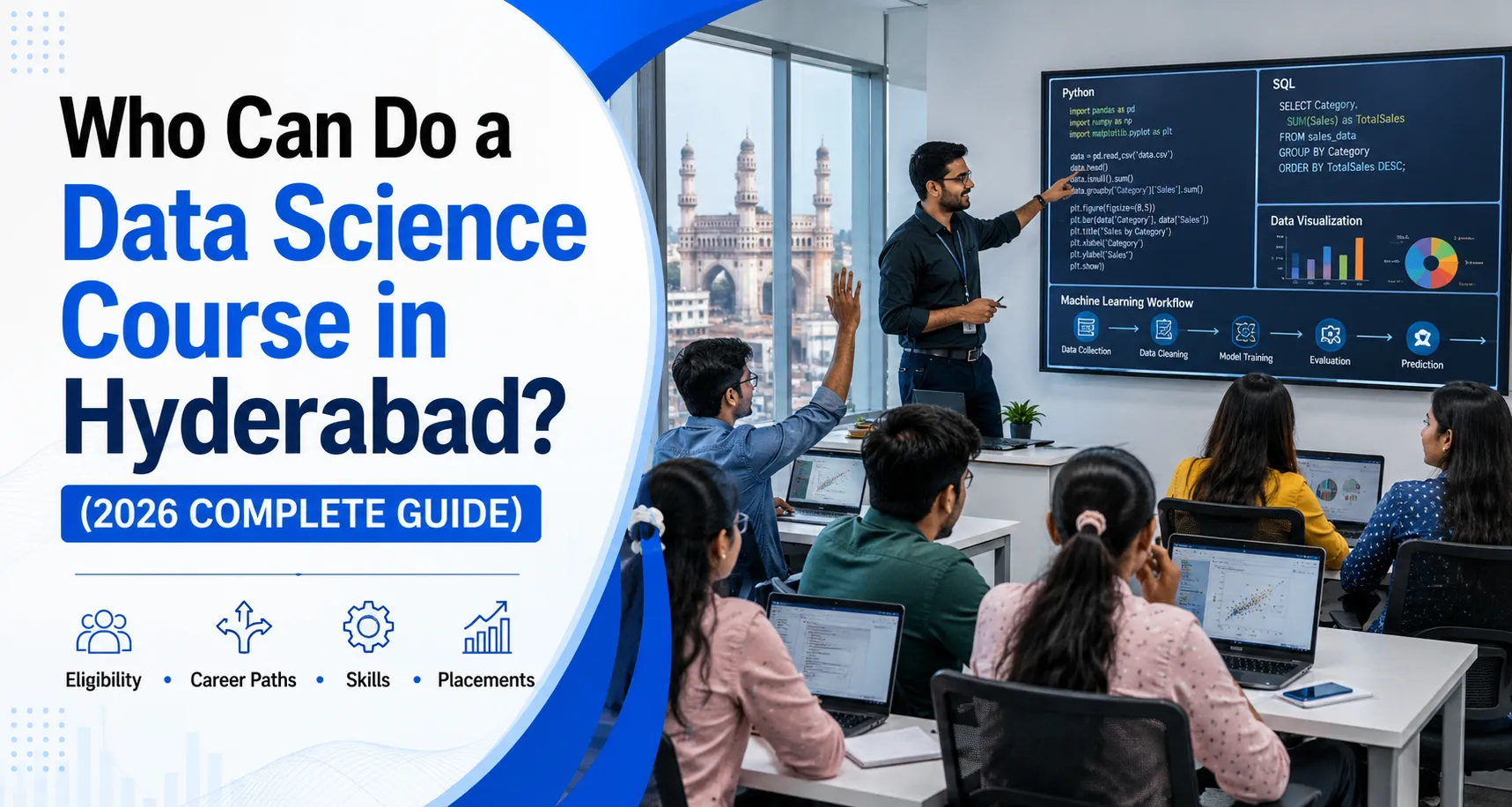
Who Can Do a Data Science Course in Hyderabad? (2026 Complete Guide)
Written by: VijaNaar
Last updated: July 29, 2026
Who Can Do a Data Science Course?
Anyone with an interest in technology, data, and problem-solving can learn data science. Students after 10th or 12th, graduates from any stream, working professionals, and career changers can all pursue a data science course. While some university programs have specific eligibility requirements, many certification and industry-focused courses are open to learners from Science, Commerce, and Arts backgrounds.
Quick Summary
- Students from Science, Commerce, and Arts can learn data science.
- You can start after 10th, 12th, graduation, or while working.
- Most beginner courses do not require prior coding experience.
- Degree programs have different eligibility requirements than certification courses.
- Practical skills, projects, and continuous learning matter more than your academic background.
- Hyderabad offers excellent opportunities for learning and career growth in data science.
Why Are More People Choosing Data Science?
Data has become one of the most valuable resources for businesses.
Every day, companies collect information from websites, mobile apps, online shopping platforms, hospitals, banks, manufacturing systems, and social media. However, raw data has little value until someone can analyze it and convert it into meaningful insights.
That's where data science professionals play an important role.
Why Data Science Is in High Demand
Today, organizations use data science to:
- Improve customer experiences
- Predict future trends
- Detect fraud
- Optimize business operations
- Develop AI-powered products
- Support strategic decision-making
As industries continue adopting Artificial Intelligence and automation, the demand for professionals with data science skills continues to grow.
What Is Data Science?
Data science is the process of collecting, organizing, analyzing, and interpreting data to solve real-world problems.
Core Skills Required in Data Science
It combines several disciplines, including:
- Programming
- Statistics
- Mathematics
- Data Analysis
- Machine Learning
- Artificial Intelligence
- Data Visualization
Businesses use these skills to make smarter decisions, automate processes, improve products, and identify new opportunities.
Because every industry generates data, data science professionals can work in healthcare, finance, retail, education, logistics, manufacturing, telecommunications, and many other sectors.
Who Can Do a Data Science Course?
One of the biggest misconceptions is that only engineering students or programmers can learn data science.
The reality is much different.
Who Can Start Learning Data Science?
Today, data science courses are designed for learners from diverse educational and professional backgrounds.
You can pursue a data science course if you are:
- A student after 10th
- A student after 12th
- A college student
- A graduate
- A postgraduate
- A working professional
- A career changer
- A business owner who wants to understand analytics
- Someone with no prior programming experience
Your willingness to learn is often more important than your previous academic stream.
Who Is Eligible for a Data Science Course?
Eligibility depends on the type of program you choose.
Eligibility by Course Type
Here's a simple comparison.
| Course Type | Typical Eligibility |
| Certificate Course | Open to most learners |
| Diploma Program | Usually Class 12 or equivalent |
| Undergraduate Degree | Class 12 with institution-specific admission requirements |
| Postgraduate Degree | Bachelor's degree from a recognized institution |
| Industry-Focused Training | Students, graduates, and working professionals |
Always review the admission requirements of the institution before applying, as eligibility criteria may vary.
Data Science Eligibility Criteria in India
There is no single national eligibility standard for every data science course in hyderabad.
Different institutions follow different admission policies depending on the program.
Certificate Programs
Usually suitable for:
- Beginners
- Students
- Graduates
- Working professionals
Most do not require previous coding knowledge.
Diploma Programs
Many diploma courses require:
- Completion of Class 12
- Basic computer knowledge
Some institutes may have additional admission criteria.
Undergraduate Programs
Popular options include:
- B.Sc. Data Science
- BCA with Data Science
- B.Tech AI & Data Science
Admission requirements vary by university and may include minimum academic marks or entrance examinations for specific programs.
Postgraduate Programs
Master's programs generally require:
- A bachelor's degree
- Institution-specific eligibility requirements
Some universities may also prefer applicants with mathematics, computer science, engineering, or related academic backgrounds.
Data Science Eligibility After 10th
Many students wonder whether they can start learning data science immediately after completing Class 10.
The answer is yes, but the type of course matters.
Can You Start Learning Data Science After 10th?
While most universities require Class 12 for undergraduate degree programs, students after 10th can begin building foundational skills through:
- Python programming
- Basic computer science
- Excel
- Logical reasoning
- Mathematics
- Introductory coding courses
Developing these skills early can make the transition into advanced data science learning much smoother after completing higher secondary education.
Data Science Eligibility After 12th
Completing Class 12 opens several pathways into data science.
Students can pursue:
- B.Sc. Data Science
- BCA with Data Science specialization
- B.Tech Artificial Intelligence & Data Science
- Certification programs
- Diploma courses
- Industry-focused training
Students from different streams can also build successful careers with the right learning approach.
Science Students
Students with Mathematics often have a strong foundation in logical thinking and quantitative analysis.
Popular options include:
- B.Tech AI & Data Science
- B.Sc. Data Science
- Computer Science degrees
Commerce Students
Commerce students can transition successfully into data science by learning:
- Python
- SQL
- Statistics
- Excel
- Power BI
Their understanding of finance and business processes can be valuable in analytics and business intelligence roles.
Arts Students
Arts students are increasingly entering technology careers through structured learning.
With consistent practice, they can build careers in:
- Marketing Analytics
- Customer Analytics
- HR Analytics
- Business Intelligence
- Research Analytics
Your stream influences your starting point—not your long-term career potential.
Which Course Is Best for Becoming a Data Scientist After 12th?
The best course depends on your career goals.
Best Learning Path Based on Your Career Goals
| Goal | Recommended Learning Path |
| Academic qualification | B.Sc. Data Science |
| Engineering career | B.Tech AI & Data Science |
| Computer applications | BCA with Data Science |
| Quick skill development | Certification Course |
| Practical, industry-focused learning | Job-oriented Data Science Bootcamp |
| Working alongside college | Live online certification |
Instead of choosing the longest course, select one that provides:
- Updated curriculum
- Practical projects
- Industry tools
- Mentor guidance
- Career support
- Portfolio development
These factors often have a greater impact on employability than course duration alone.
Common Myths About Data Science Eligibility
Many aspiring learners delay starting because of common misconceptions.
Myth 1: Only Engineering Students Can Learn Data Science
Reality: Students from Science, Commerce, Arts, and other backgrounds can all build successful careers with the right training and consistent practice.
Myth 2: You Must Know Coding Before Joining
Reality: Many beginner-friendly certification programs start with Python from the basics, making them accessible even to learners with no programming experience.
Myth 3: You Need Advanced Mathematics
Reality: A basic understanding of mathematics and statistics is helpful, but most courses teach these concepts gradually alongside practical applications.
Myth 4: It's Too Late to Start After Graduation
Reality: Many graduates and working professionals successfully transition into data science through structured learning, projects, and continuous upskilling.
Data Science Course Eligibility After Graduation
Graduation is one of the most common stages at which people decide to transition into data science.
Whether you've completed a degree in engineering, commerce, science, arts, management, or another field, there are multiple pathways to build a career in data science.
Many certification programs, diploma courses, and industry-focused training programs are specifically designed for graduates who want to upskill or switch careers.
Graduates Who Can Pursue Data Science
You can consider a data science course if you have completed:
- B.Tech or BE
- B.Sc.
- BCA
- B.Com
- BBA
- BA
- MBA
- MCA
- M.Sc.
- Or another recognized bachelor's degree
Your previous degree may influence your starting point, but it doesn't determine your ability to succeed in data science.
Recommended Learning Paths After Graduation
| Graduation Background | Recommended Course |
| B.Tech / BE | Industry-focused Data Science Program or M.Sc. |
| B.Sc. | Certification or Advanced Diploma |
| BCA | Data Science Certification + Machine Learning |
| B.Com | Data Analytics + Data Science |
| BBA | Business Analytics + Data Science |
| BA | Beginner Certification Program |
| MBA | AI, Business Analytics, or Data Science Specialization |
| Working Professionals | Weekend, Online, or Hybrid Programs |
The best learning path depends on your existing skills, career goals, and preferred learning format.
Who Can Do a Data Science Course Online?
Online learning has made data science more accessible than ever.
If you have a computer, internet access, and the motivation to learn, you can build data science skills from almost anywhere.
Benefits of Learning Data Science Online
Online courses are suitable for:
- College students
- Graduates
- Working professionals
- Freelancers
- Entrepreneurs
- Career changers
- Learners returning after a career break
Many live online programs also include mentor support, assignments, project reviews, and career guidance, offering an experience similar to classroom training.
Can Commerce Students Learn Data Science?
Absolutely. Commerce students often bring valuable business knowledge that complements technical skills in analytics.
After learning tools such as Python, SQL, Excel, and Power BI, Commerce graduates can explore roles involving:
Career Opportunities for Commerce Students
- Financial Analytics
- Business Intelligence
- Risk Analysis
- Banking Analytics
- Retail Analytics
- Sales Analytics
Understanding business operations can be a significant advantage when interpreting data and making recommendations.
Can Arts Students Learn Data Science?
Yes.
Many people assume that Arts students cannot enter technology careers, but that's a misconception.
With structured learning and regular practice, Arts graduates can develop technical skills while applying their strengths in communication, research, and critical thinking.
Career Opportunities for Arts Students
- Marketing Analytics
- Customer Insights
- HR Analytics
- Research Analytics
- Business Intelligence
- Digital Analytics
Success depends more on commitment and practical learning than on your academic stream.
Can Science Students Learn Data Science?
Science students are naturally well-positioned for data science because many have already studied mathematics, logical reasoning, or computer science.
Best Data Science Options for Science Students
Common pathways include:
- B.Sc. Data Science
- B.Tech AI & Data Science
- Computer Science
- Industry-focused certification programs
Their analytical background often helps when learning statistics and machine learning, but practical skills and projects remain equally important.
Can Working Professionals Learn Data Science?
Yes.
Many professionals choose data science to:
- Upskill in their current role
- Transition into analytics
- Move toward AI-related careers
- Improve career opportunities
- Learn modern technology skills
Professionals from industries such as finance, healthcare, sales, operations, education, and IT often pursue weekend, evening, or hybrid programs to balance learning with work.
Benefits of Learning Data Science While Working
Flexible learning options make it easier to continue developing skills without leaving your job.
Can Career Changers Enter Data Science?
Definitely.
Data science is one of the most popular career transition choices because its skills are valuable across industries.
Popular Career Transition Paths
People successfully move into data science from backgrounds such as:
- Accounting
- Banking
- Marketing
- Customer Support
- Teaching
- Mechanical Engineering
- Civil Engineering
- Human Resources
- Operations
- Healthcare
A structured roadmap, practical projects, and consistent learning can help make the transition smoother.
Data Science Course Fees and Duration
The cost and duration of a data science course depend on the type of program you choose.
Instead of comparing programs only by price, consider what is included—such as mentor guidance, hands-on projects, career preparation, and placement support.
Course Fees and Duration Comparison
| Course Type | Typical Duration | Typical Fee Range (₹) |
| Certificate Course | 3–6 Months | ₹20,000–₹80,000 |
| Diploma Program | 6–12 Months | ₹40,000–₹1,50,000 |
| Industry-Focused Bootcamp | Around 4 Months | Varies by curriculum |
| Bachelor's Degree | 3–4 Years | Varies by university |
| Master's Degree | 2 Years | Varies by university |
These figures are indicative and can vary depending on the institution, curriculum, learning format, and support services offered.
Skills You Should Develop Before Starting
You don't need to master these skills before enrolling, but being familiar with them can make your learning journey easier.
Technical Skills
A beginner-friendly data science course should gradually introduce you to:
- Python Programming
- SQL
- Excel
- Statistics
- Data Cleaning
- Exploratory Data Analysis (EDA)
- Data Visualization
- Power BI
- Tableau
- Machine Learning fundamentals
- Artificial Intelligence basics
- Generative AI concepts
These topics form the foundation of most modern data science programs.
Professional Skills
Alongside technical knowledge, employers also value:
- Problem-solving
- Critical thinking
- Communication
- Curiosity
- Teamwork
- Time management
- Attention to detail
- Business understanding
Developing these skills helps you work effectively in real-world projects and collaborate with cross-functional teams.
Beginner Roadmap to Become a Data Scientist
If you're starting from scratch, here's a practical learning sequence.
Step-by-Step Learning Roadmap
| Stage | Focus Area |
| Stage 1 | Learn Python fundamentals |
| Stage 2 | Understand SQL and databases |
| Stage 3 | Build Excel and data analysis skills |
| Stage 4 | Study statistics and probability |
| Stage 5 | Learn data visualization using Power BI or Tableau |
| Stage 6 | Explore machine learning fundamentals |
| Stage 7 | Complete real-world projects |
| Stage 8 | Build a portfolio and prepare for interviews |
Don't rush through the roadmap. Spend time applying what you learn through hands-on practice and projects.
Choosing the Right Course for Your Background
Before enrolling, ask yourself a few important questions.
Questions to Ask Before Choosing a Course
- Am I looking for an academic degree or practical job-ready skills?
- Does the curriculum include Python, SQL, statistics, and machine learning?
- Will I work on real datasets and capstone projects?
- Are experienced mentors available for guidance?
- Does the institute provide resume reviews and mock interviews?
- Is career or placement support available?
- Can I balance the course with my current studies or job?
Answering these questions will help you select a program that aligns with your goals rather than simply choosing the shortest or least expensive option.
Can Anyone Learn Data Science?
Yes.
One of the biggest myths about data science is that it's only for programmers or engineering graduates.
In reality, people from a wide range of educational and professional backgrounds have successfully built careers in data science.
Why Anyone Can Build a Career in Data Science
What matters most is your willingness to learn, practice consistently, and solve problems using data.
You don't need to know everything before you start.
Most beginner-friendly courses teach concepts step by step, beginning with Python, SQL, and data analysis before introducing advanced topics like machine learning and artificial intelligence.
Whether you're a student, graduate, working professional, or career changer, it's possible to learn data science with the right guidance and consistent effort.
Is Data Science an IT Job?
This is one of the most frequently searched questions—and the answer is a little more nuanced than a simple yes or no.
Data science is closely connected to the IT industry because professionals work with:
- Programming languages
- Databases
- Cloud platforms
- Machine learning frameworks
- Data visualization tools
Why Data Science Is More Than Traditional IT
However, data science is much broader than traditional software development.
Data Scientists collaborate with teams across:
- Finance
- Healthcare
- Retail
- Manufacturing
- Marketing
- Telecommunications
- Education
- Logistics
Instead of primarily building software, they analyze data, identify patterns, create predictive models, and help organizations make informed decisions.
This combination of technology, mathematics, statistics, and business makes data science an interdisciplinary career.
Is Data Science a Safe Career?
Yes.
Data science continues to be one of the fastest-growing career fields because organizations across industries are becoming increasingly data-driven.
Businesses generate massive amounts of information every day and need professionals who can transform that data into meaningful insights.
Future Scope of Data Science Careers
As technologies like Artificial Intelligence, Machine Learning, and automation continue to evolve, professionals with strong analytical skills are expected to remain valuable.
Rather than replacing data scientists, AI is changing how they work. Modern data professionals increasingly use AI-powered tools to improve productivity while focusing on higher-value tasks such as problem-solving, decision-making, and strategy.
For learners who continue updating their skills, data science offers strong long-term career potential.
Is Data Science Highly Paid?
Data science is often associated with competitive salaries because it combines technical expertise with business problem-solving.
However, there isn't a fixed salary for every Data Scientist.
Factors That Affect Data Scientist Salaries
Your earning potential depends on factors such as:
- Technical skills
- Educational qualifications
- Practical experience
- Internship experience
- Industry
- Company
- Location
- Project portfolio
Instead of focusing only on compensation, invest time in building practical experience through projects, internships, and continuous learning.
Professionals who consistently improve their skills are generally better positioned for career growth over time.
Career Opportunities After a Data Science Course
One of the biggest strengths of data science is its versatility.
Organizations across industries hire professionals who can collect, analyze, and interpret data to improve business outcomes.
Popular Data Science Job Roles
| Job Role | Primary Responsibilities |
| Data Analyst | Analyze data, prepare reports, and identify trends |
| Junior Data Scientist | Build predictive models and support analytics projects |
| Business Analyst | Solve business problems using data insights |
| Machine Learning Engineer | Develop machine learning solutions |
| AI Engineer | Build AI-powered systems and applications |
| Data Engineer | Design and maintain data pipelines |
| BI Developer | Create dashboards using Power BI or Tableau |
| Analytics Consultant | Help organizations make data-driven decisions |
Many professionals begin their careers as Data Analysts before moving into more specialized AI, Machine Learning, or Data Engineering roles.
What Skills Do Employers Look For?
Recruiters don't hire candidates based only on certificates.
They look for people who can demonstrate practical knowledge and solve real business problems.
Technical Skills Employers Expect
A modern data science program should help you build expertise in:
- Python Programming
- SQL
- Excel
- Statistics
- Data Cleaning
- Exploratory Data Analysis (EDA)
- Data Visualization
- Power BI
- Tableau
- Machine Learning
- Deep Learning fundamentals
- Generative AI concepts
- Large Language Models (LLMs)
- Git and GitHub
These skills help you build projects that demonstrate your capabilities to potential employers.
Professional Skills That Make You Stand Out
Technical knowledge becomes much more valuable when combined with strong professional skills.
Employers also look for candidates who can demonstrate:
- Critical thinking
- Problem-solving
- Communication
- Teamwork
- Curiosity
- Adaptability
- Presentation skills
- Time management
Being able to explain your analysis clearly is often just as important as writing code.
What Is the Salary of a Data Scientist After 5 Years?
A common question from aspiring professionals is:
"What can I expect to earn after five years?"
There isn't a universal answer.
Career Growth After Five Years
Career progression depends on:
- Your technical expertise
- Continuous learning
- Industry specialization
- Company
- Leadership responsibilities
- Portfolio quality
- Professional certifications
After several years of experience, many professionals move into roles such as:
- Senior Data Scientist
- Machine Learning Engineer
- AI Engineer
- Analytics Manager
- Data Engineering Specialist
- AI Consultant
As responsibilities increase, earning potential often grows as well. Building strong technical skills and delivering measurable business value usually has a greater impact than simply accumulating years of experience.
Why Hyderabad Is One of the Best Cities to Learn Data Science
Hyderabad has established itself as one of India's leading technology hubs.
The city is home to organizations working in:
- Software Development
- Artificial Intelligence
- Cloud Computing
- Healthcare Technology
- FinTech
- Cybersecurity
- Analytics
Benefits of Learning Data Science in Hyderabad
For students and professionals, this creates several advantages.
Learning in Hyderabad provides opportunities to:
- Attend industry events
- Network with professionals
- Explore internship opportunities
- Participate in workshops
- Connect with technology companies
The city's growing technology ecosystem makes it an attractive place for anyone planning a career in data science.
How to Choose the Best Data Science Institute
Choosing the right institute is just as important as choosing the right course.
Before enrolling, compare programs using the following checklist.
Industry-Relevant Curriculum
The curriculum should include:
- Python
- SQL
- Statistics
- Data Visualization
- Power BI
- Machine Learning
- Deep Learning fundamentals
- Generative AI
- Capstone projects
A modern curriculum reflects the tools and technologies used in today's workplace.
Practical Learning
Employers value hands-on experience.
Look for programs that include:
- Real datasets
- Industry case studies
- Live coding
- Portfolio development
- Capstone projects
Projects help demonstrate your skills during interviews.
Experienced Mentors
Mentors can help you:
- Understand difficult concepts
- Review your projects
- Improve coding practices
- Prepare for technical interviews
- Stay motivated throughout your learning journey
Learning from experienced professionals often accelerates your progress.
Career Support
An effective training program should also provide:
- Resume building
- LinkedIn profile optimization
- Mock interviews
- Career counseling
- Placement assistance
These services help learners transition from training to employment.
Flexible Learning Options
Different learners have different schedules.
Choose a program that offers options such as:
- Classroom training
- Live online learning
- Hybrid classes
- Weekend batches
Flexible formats help students and working professionals learn consistently.
Why Students Choose Vijanaar
If you're searching for a Data Science course in Hyderabad, it's important to choose a program that emphasizes practical learning alongside theory.
At Vijanaar, learners build industry-relevant skills through structured, hands-on training designed to prepare them for real-world challenges.
What You'll Learn at Vijanaar
The curriculum introduces topics such as:
- Python Programming
- SQL
- Statistics
- Data Analysis
- Power BI
- Machine Learning
- Deep Learning fundamentals
- Generative AI concepts
- Large Language Models (LLMs)
- Capstone projects using real datasets
Career Support at Vijanaar
Beyond technical training, students receive support through:
- Resume preparation
- LinkedIn profile guidance
- Mock interviews
- Career mentoring
- Placement assistance
The focus is on helping learners develop practical skills, build a professional portfolio, and prepare confidently for entry-level opportunities in data science and analytics.
People Also Ask (PAA)
Can Commerce students become Data Scientists?
Yes. Commerce students can successfully build careers in data science by learning Python, SQL, statistics, Excel, and data visualization tools. Their understanding of finance, business operations, and accounting can be be valuable in banking, business intelligence, and financial analytics roles.
Why Commerce Students Can Succeed
Business knowledge combined with technical skills makes Commerce graduates valuable in analytics-driven roles.
Can Arts students do a Data Science course?
Yes. Arts students can enroll in many beginner-friendly certification programs and industry-focused courses. By developing programming, analytical thinking, and problem-solving skills, they can pursue careers in marketing analytics, HR analytics, customer insights, and business intelligence.
Career Options for Arts Students
- Marketing Analytics
- HR Analytics
- Customer Insights
- Business Intelligence
- Research Analytics
Do I need coding experience before joining a Data Science course?
No.
Many beginner-level programs teach Python programming from the basics before introducing advanced concepts such as machine learning and artificial intelligence. With consistent practice and mentor guidance, learners without previous coding experience can build strong technical skills.
Beginner-Friendly Learning Path
Most courses begin with Python, SQL, Excel, and statistics before moving into advanced AI concepts.
Can working professionals switch to Data Science?
Yes.
Many professionals transition into data science while continuing their current jobs. Flexible learning options such as live online classes, hybrid programs, and weekend batches make it easier to balance work with skill development.
Best Learning Formats for Professionals
- Weekend Batches
- Live Online Classes
- Hybrid Learning
- Self-paced Learning with Mentor Support
Which educational background is best for Data Science?
Students from Science, Commerce, Arts, Engineering, Business, and many other disciplines can succeed in data science.
While mathematics and programming may provide an initial advantage, long-term success depends more on continuous learning, practical projects, and problem-solving ability than on your academic background.
Key Skills Matter More Than Your Degree
Employers typically value:
- Practical Projects
- Technical Skills
- Portfolio
- Problem-solving Ability
- Communication Skills
Final Thoughts
If you've been asking "Who can do a Data Science course?", the answer is simple:
Data science is open to far more people than many realize.
Whether you're:
- A student after Class 10 or 12
- A college student
- A graduate
- A working professional
- A career changer
- A business professional looking to build analytical skills
there are learning paths designed to match your experience and career goals.
Instead of focusing on your academic background, concentrate on building practical skills in Python, SQL, statistics, machine learning, and data analysis. Combine those skills with real-world projects, and you'll be much better prepared for opportunities in today's data-driven economy.
Employers typically value demonstrated skills and problem-solving ability more than your original academic stream.
Frequently Asked Questions
Who is eligible for a Data Science course?
Is Data Science highly paid?
Can anyone learn Data Science?
Can a 12th pass become a Data Scientist?
Is Data Science an IT job?
Which is better, CA or Data Scientist?
Is Data Science a safe career?
Which job gives a ₹1 crore salary?
What is the salary of a Data Scientist after 5 years?
Written by VijaNaar
VijaNaar is Hyderabad's leading AI & Data Science training institute, empowering students and professionals with industry-ready skills since 2019.


