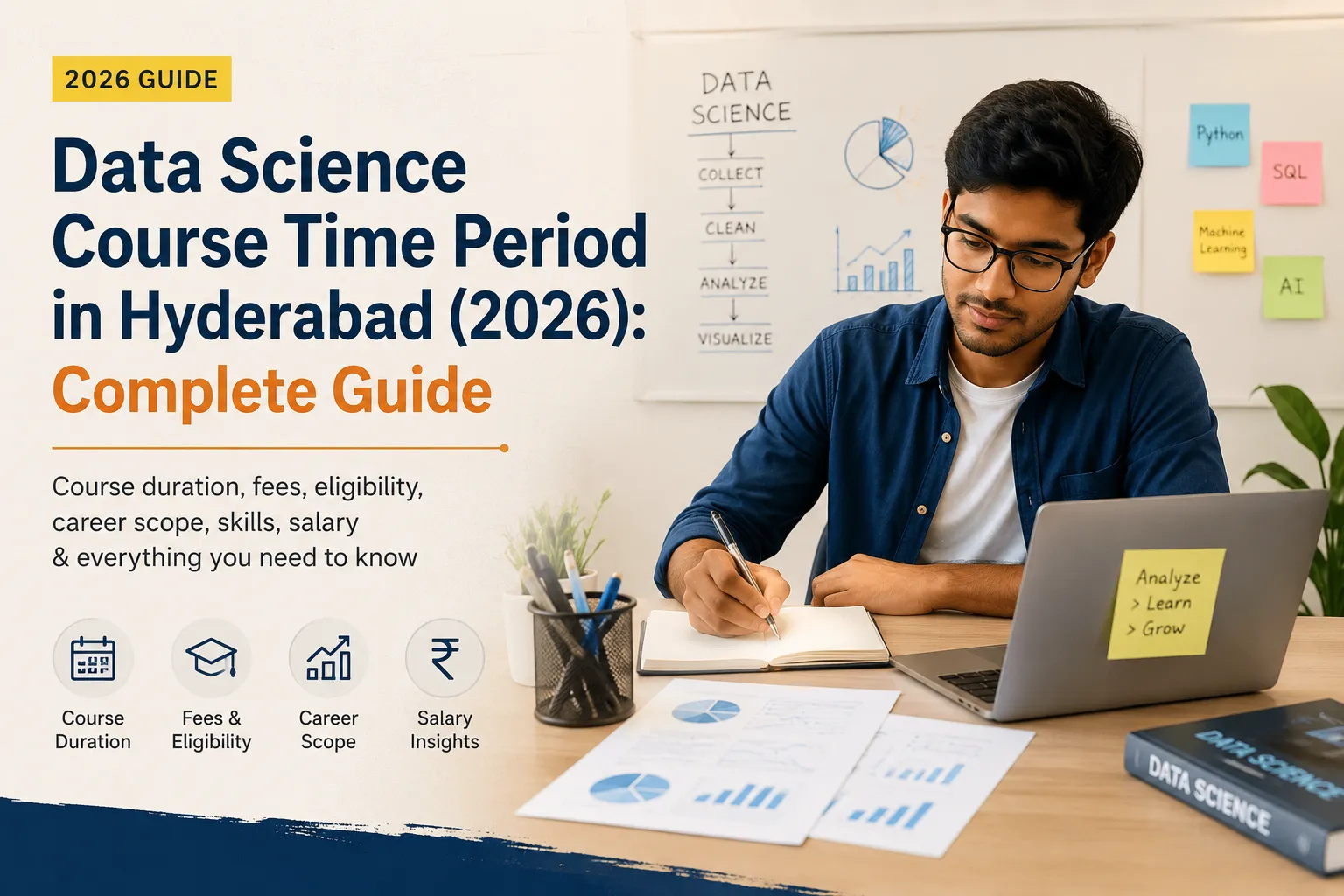
Data Science Course Time Period in Hyderabad (2026): Complete Guide
Written by: VijaNaar
Last updated: July 29, 2026
What Is the Time Period for a Data Science Course?
The time period for a data science course depends on the type of program you choose. Certificate courses usually take 3–6 months, diploma programs last 6–12 months, bachelor's degrees require 3–4 years, and master's degrees generally take 2 years. Industry-focused, placement-oriented programs can often help learners build job-ready skills in around 4 months through structured, practical training.
Quick Summary
- Data science courses range from 3 months to 4 years.
- Certificate courses: 3–6 months
- Diploma programs: 6–12 months
- Bachelor's degree: 3–4 years
- Master's degree: 2 years
- Practical, mentor-led programs often focus on job readiness in around 4 months.
- Choose a course based on your career goals—not just the duration.
Why Understanding Course Duration Matters
When students begin exploring a career in data science, one of the first questions they ask is, "How long will it take to complete a data science course?"
It's an important question, but duration alone doesn't tell the full story.
Two programs might both last six months, yet one may include live mentoring, real-world projects, career preparation, and portfolio development, while the other consists mainly of recorded video lessons.
The value of a course depends on what you learn, how you apply those skills, and how well the program prepares you for real-world roles.
Rather than choosing the shortest course available, focus on whether it provides the technical foundation and practical experience needed to build confidence and pursue your career goals.
What Is Data Science?
Data science is the process of collecting, organising, analysing, and interpreting data to solve business problems and support informed decision-making.
It combines multiple disciplines, including:
- Programming
- Statistics
- Mathematics
- Data Analysis
- Machine Learning
- Artificial Intelligence
- Data Visualisation
Organisations use data science to improve customer experiences, optimise operations, predict trends, detect fraud, and automate decision-making.
Because these skills are valuable across industries, data science professionals work in healthcare, finance, retail, manufacturing, education, logistics, and technology.
Why Does the Time Period Vary?
There isn't a single standard duration because different courses are designed for different purposes.
For example:
- A university degree focuses on academic knowledge, research, and long-term learning.
- A certification program introduces core technical skills.
- A placement-oriented bootcamp emphasises practical learning, projects, and career preparation.
Factors Affecting Course Duration
The time required depends on several factors:
- Course type
- Learning format
- Curriculum depth
- Practical assignments
- Mentor support
- Career services
- Student learning pace
This is why you'll find programs ranging from a few months to several years.
Data Science Course Time Period Comparison
| Course Type | Typical Duration | Best For |
| Certificate Course | 3–6 Months | Beginners exploring data science |
| Diploma Program | 6–12 Months | Students seeking deeper technical knowledge |
| Industry-Focused Bootcamp | Around 4 Months | Practical learning and portfolio building |
| B.Sc. Data Science | 3 Years | Undergraduate specialization |
| BCA with Data Science | 3 Years | Computer applications with analytics |
| B.Tech AI & Data Science | 4 Years | Engineering-focused students |
| M.Sc. Data Science | 2 Years | Graduates pursuing advanced specialization |
This comparison provides a general guideline. Always review the curriculum and learning outcomes before enrolling.
Different Types of Data Science Courses
Certificate Courses (3–6 Months)
Certificate programs are a popular starting point for beginners because they focus on essential, job-relevant skills in a relatively short timeframe.
Topics often include:
- Python
- SQL
- Excel
- Statistics
- Data Visualisation
- Exploratory Data Analysis (EDA)
- Introduction to Machine Learning
These courses are suitable for students, graduates, and working professionals who want to build foundational knowledge.
Diploma Programs (6–12 Months)
Diploma programs generally offer broader coverage than short-term certifications.
Students may learn:
- Advanced Python
- SQL
- Statistics
- Machine Learning
- Deep Learning fundamentals
- Data Engineering basics
- Business case studies
- Capstone projects
These programs provide additional time for practical assignments and project work.
Bachelor's Degree (3–4 Years)
Students who wish to specialise in data science from the beginning of their higher education can pursue undergraduate degrees such as:
- B.Sc. Data Science
- B.Tech Artificial Intelligence & Data Science
- BCA with Data Science specialization
These programs combine technical subjects with general academic education over multiple years.
Master's Degree (2 Years)
A master's degree is suitable for graduates who want advanced knowledge in:
- Artificial Intelligence
- Machine Learning
- Big Data
- Research
- Predictive Analytics
- Data Engineering
This pathway is often chosen by students planning to pursue specialised technical or research-oriented careers.
Which Time Period Is Right for You?
There isn't a single answer because every learner has different goals.
Choose based on your objective:
- Want foundational skills? → Certificate program.
- Want deeper technical training? → Diploma.
- Want an academic qualification? → Bachelor's degree.
- Already graduated? → Master's degree or industry-focused training.
- Want practical job-ready skills? → Placement-oriented program with projects and mentor support.
The best course isn't always the longest—it's the one that aligns with your learning goals and helps you apply your knowledge in real-world situations.
Data Science Course Fees and Duration
One of the most common questions students ask is:
"How much does a data science course cost, and how long does it take?"
The answer depends on the type of course, the learning format, the curriculum, and the level of mentor and career support provided.
Instead of comparing courses based only on fees, consider the overall value. A program that includes live mentoring, real-world projects, interview preparation, and placement assistance often provides a stronger return on your investment than one focused solely on recorded lectures.
Course Fees and Duration Comparison
| Course Type | Duration | Typical Fee Range (₹) | Best For |
| Certificate Course | 3–6 Months | ₹20,000–₹80,000 | Beginners |
| Diploma Program | 6–12 Months | ₹40,000–₹1,50,000 | Skill development |
| Industry-Focused Bootcamp | Around 4 Months | Varies by curriculum and career support | Job-ready learners |
| B.Sc. Data Science | 3 Years | Varies by university | Undergraduate students |
| BCA with Data Science | 3 Years | Varies by university | Computer applications |
| B.Tech AI & Data Science | 4 Years | Varies by university | Engineering students |
| M.Sc. Data Science | 2 Years | Varies by university | Graduates |
Rather than choosing the least expensive option, evaluate the curriculum, practical projects, mentor access, and placement support.
Data Science Course Fees Per Year
Students considering a bachelor's or master's degree often want to understand annual tuition rather than the total program cost.
The yearly fee depends on factors such as:
- Government or private institution
- University reputation
- Infrastructure and facilities
- Laboratory resources
- Industry partnerships
- Internship opportunities
- Learning mode
When comparing degree programs, don't focus solely on tuition. Look at opportunities for internships, industry projects, career services, and practical exposure.
Data Science Course Time Period After 12th
Students who complete Class 12 have several learning options depending on their career goals.
If You Want an Undergraduate Degree
Choose one of the following:
- B.Sc. Data Science
- B.Tech Artificial Intelligence & Data Science
- BCA with Data Science specialization
These programs generally require 3 to 4 years and provide academic knowledge alongside technical subjects.
If You Want Practical Skills Alongside College
Many students complete:
- Certification programs
- Online instructor-led training
- Industry bootcamps
These typically take 3–6 months or around 4 months for structured, project-based learning.
This combination allows students to build practical skills while pursuing a university degree.
Data Science Course Time Period After Graduation
Graduates often have different priorities than students after Class 12.
Many are looking to:
- Switch careers
- Upskill
- Prepare for analytics roles
- Enter AI-related fields
Recommended Programs Based on Your Background
| Background | Recommended Program |
| Engineering | Industry-focused bootcamp or M.Sc. |
| B.Sc. | Certification or Diploma |
| B.Com | Data Analytics + Data Science Certification |
| BBA | Business Analytics + Data Science |
| MBA | Advanced Analytics or AI programs |
| Working Professionals | Weekend or Hybrid Programs |
Graduates with programming experience may progress more quickly through beginner topics, while learners from non-technical backgrounds may spend additional time building foundational skills.
Data Science Eligibility After 12th
A common misconception is that only Science students can study data science.
In reality, many institutions and certification providers welcome learners from multiple academic backgrounds.
Science Students
Students with Mathematics often have a strong foundation for:
- Programming
- Statistics
- Machine Learning
Popular degree options include:
- B.Tech AI & Data Science
- B.Sc. Data Science
- Computer Science
Commerce Students
Commerce students can build successful careers by learning:
- Python
- SQL
- Excel
- Statistics
- Power BI
Their understanding of finance and business processes can be particularly valuable in analytics and business intelligence roles.
Arts Students
Arts students are also eligible for many certification and undergraduate programs.
With structured learning, they can develop skills for careers in:
- Marketing Analytics
- Customer Insights
- HR Analytics
- Research Analytics
- Business Intelligence
Your stream may influence your starting point, but it doesn't determine your long-term success in data science.
Which Course Duration Should You Choose?
Choosing the right time period depends on where you are in your career journey.
Choose a Certificate Course If You:
- Are exploring data science for the first time
- Want to build foundational skills
- Need flexible learning
- Are studying in college
- Want to upskill alongside another degree
Choose a Diploma If You:
- Want broader technical coverage
- Prefer additional project work
- Have more time available
- Plan to specialise before applying for jobs
Choose a Degree If You:
- Have recently completed Class 12
- Want an academic qualification
- Prefer structured university education
- Plan to continue into postgraduate studies
Choose an Industry-Focused Program If You:
- Want practical learning
- Prefer mentor guidance
- Want to build a portfolio
- Need interview preparation
- Are aiming for entry-level industry roles
Remember, employers are generally more interested in your skills, projects, and problem-solving abilities than the number of months listed on your course certificate.
Sample Learning Timeline
Here's an example of how a beginner might progress through a structured learning journey.
Beginner Data Science Learning Roadmap
| Timeline | Focus Area |
| Weeks 1–2 | Python Fundamentals |
| Weeks 3–4 | SQL and Database Basics |
| Month 2 | Statistics, Excel, Data Cleaning |
| Month 3 | Exploratory Data Analysis and Data Visualization |
| Month 4 | Machine Learning Fundamentals |
| Month 5 | Capstone Projects and GitHub Portfolio |
| Month 6 | Resume Building, Mock Interviews, Career Preparation |
This roadmap is only an example. Your learning pace may vary depending on your background, available study time, and course format.
What Makes a Course Worth the Time?
The best data science course isn't necessarily the one with the longest duration—it’s the one that helps you build practical, job-ready skills.
Questions to Ask Before Choosing a Course
When comparing programs, ask yourself:
- Does the curriculum cover Python, SQL, and statistics?
- Will I work on real datasets?
- Are industry projects included?
- Will I build a portfolio?
- Is mentor support available?
- Does the course include resume reviews and mock interviews?
- Is the curriculum updated with AI and Generative AI concepts?
A course that answers "yes" to most of these questions is more likely to prepare you for real-world opportunities than one that focuses only on classroom theory.
What Career Opportunities Are Available After Completing a Data Science Course?
One of the biggest advantages of learning data science is that your skills can be applied across almost every industry. Today, organizations rely on data to improve products, understand customer behavior, automate workflows, and make better business decisions.
Industries That Hire Data Science Professionals
As a result, data science professionals are in demand across sectors such as:
- Information Technology
- Banking and Financial Services
- Healthcare
- E-commerce
- Retail
- Manufacturing
- Telecommunications
- Logistics
- Education
- Digital Marketing
Rather than being limited to one career path, data science gives you the flexibility to explore multiple roles as your skills and experience grow.
Career Options After Completing a Data Science Course
Depending on your education, technical skills, and practical experience, you can pursue roles such as:
Popular Data Science Job Roles
| Job Role | What You'll Do |
| Data Analyst | Analyze datasets, create reports, and identify trends |
| Business Analyst | Use data to solve business problems and improve processes |
| Junior Data Scientist | Build predictive models and analyze large datasets |
| Machine Learning Engineer | Develop and optimize machine learning solutions |
| AI Engineer | Build AI-powered applications and automation systems |
| Data Engineer | Design and maintain data pipelines |
| BI Developer | Create dashboards using Power BI or Tableau |
| Analytics Consultant | Help businesses make data-driven decisions |
Many professionals begin as Data Analysts before progressing into specialized Machine Learning or AI roles.
Is Data Science an IT Job?
This is one of the most frequently searched questions.
The answer is both yes and no.
Data science is closely connected to the IT industry because professionals use programming languages, databases, cloud platforms, and software tools.
Why Data Science Is More Than IT
Data Scientists also work closely with:
- Business teams
- Finance departments
- Healthcare organizations
- Manufacturing companies
- Government agencies
- Marketing teams
Their primary responsibility is not writing software applications but extracting meaningful insights from data and helping organizations make informed decisions.
That's why data science is often considered an interdisciplinary field that combines technology, mathematics, statistics, and business knowledge.
Is Data Science Very Difficult?
Data science has a reputation for being difficult because it combines multiple disciplines.
You'll learn topics such as:
- Programming
- Statistics
- Machine Learning
- Data Visualization
- Databases
- Business Analytics
For beginners, this may seem overwhelming.
How Beginners Learn Data Science
The good news is that most well-designed programs introduce these concepts gradually.
For example, you'll usually start with:
- Python basics
- Excel
- SQL
- Simple statistics
Only after building confidence do you move into machine learning and AI concepts.
Learning becomes much easier when you practice consistently and apply concepts through real projects rather than memorizing theory.
Is Data Science Full of Maths?
Mathematics plays an important role in data science, but you don't need to be a mathematics expert to get started.
Most beginner-level programs focus on practical applications rather than advanced mathematical proofs.
Maths Concepts Used in Data Science
You'll commonly use concepts such as:
- Mean
- Median
- Probability
- Percentages
- Correlation
- Basic Linear Algebra
- Introductory Calculus (for some advanced topics)
Many software libraries perform complex calculations behind the scenes, allowing learners to focus on understanding concepts and solving business problems.
A willingness to learn and practice is usually more important than having an advanced mathematics background.
Which Is Better: AI or Data Science?
Students often compare Artificial Intelligence and Data Science before choosing a course.
The truth is that these fields are closely related rather than competing.
AI vs Data Science Comparison
| Data Science | Artificial Intelligence |
| Focuses on analyzing and interpreting data | Focuses on building intelligent systems |
| Uses statistics and analytics | Uses machine learning and deep learning extensively |
| Supports business decision-making | Enables automation and intelligent behavior |
| Includes visualization and reporting | Includes computer vision, NLP, robotics, and AI models |
If you're interested in understanding data and generating insights, data science is an excellent starting point.
If you're passionate about intelligent systems and automation, AI may become a natural specialization as your career progresses.
Many modern programs introduce learners to both disciplines because they increasingly overlap in industry.
What Skills Do Employers Look for?
Employers hire candidates who can demonstrate practical abilities—not just certificates.
A strong data science course should help you build both technical and professional skills.
Technical Skills
Develop expertise in:
- Python Programming
- SQL
- Excel
- Statistics
- Data Cleaning
- Exploratory Data Analysis (EDA)
- Power BI
- Tableau
- Machine Learning
- Deep Learning fundamentals
- Generative AI concepts
- Git and GitHub
These skills form the foundation of most entry-level analytics and data science roles.
Professional Skills
Technical knowledge becomes even more valuable when combined with:
- Critical thinking
- Problem-solving
- Communication
- Presentation skills
- Business understanding
- Team collaboration
- Curiosity
- Time management
Being able to explain insights clearly is often just as important as building accurate models.
What Is the Salary of a Data Scientist?
One of the biggest attractions of data science is its long-term career potential.
However, there isn't a single fixed salary.
Compensation depends on several factors such as:
- Technical skills
- Educational background
- Internship experience
- Project portfolio
- Company
- Location
- Job role
Instead of chasing a specific salary figure, focus on becoming someone employers want to hire.
Candidates who build practical projects, contribute to GitHub, complete internships, and continue learning are generally better positioned for career growth.
Why Hyderabad Is One of the Best Places to Learn Data Science
If you're planning to study data science, Hyderabad offers several advantages.
The city has become one of India's leading technology hubs, with organizations working in:
- Artificial Intelligence
- Software Development
- Healthcare Technology
- Financial Technology
- Cloud Computing
- Cybersecurity
- Analytics
Benefits of Learning Data Science in Hyderabad
This growing ecosystem creates opportunities for:
- Industry networking
- Workshops
- Internships
- Career events
- Professional communities
For students and working professionals, learning in Hyderabad also provides better exposure to companies actively hiring for analytics and AI-related roles.
How to Choose the Best Data Science Course
Not every program delivers the same learning experience.
Before enrolling, compare courses using the following checklist.
1. Updated Curriculum
Choose a course covering:
- Python
- SQL
- Statistics
- Machine Learning
- Power BI
- Generative AI
- Industry projects
An outdated curriculum may not prepare you for current employer expectations.
2. Hands-On Learning
Look for opportunities to work on:
- Real datasets
- Business case studies
- Capstone projects
- Portfolio development
Projects help you demonstrate practical skills during interviews.
3. Experienced Mentors
Mentors should provide:
- Coding support
- Project feedback
- Career guidance
- Interview preparation
Learning from professionals can significantly shorten your learning curve.
4. Career Support
A quality course should also include:
- Resume building
- LinkedIn profile optimization
- Mock interviews
- Placement assistance
- Career counseling
These services help bridge the gap between learning and employment.
5. Flexible Learning Options
Choose a learning format that fits your schedule.
Options may include:
- Classroom training
- Live online classes
- Hybrid learning
- Weekend batches
Flexibility helps students and working professionals maintain consistency.
Why Many Students Prefer Practical, Placement-Focused Training
Employers rarely ask how many months your course lasted.
Instead, they ask:
- What projects have you completed?
- Can you explain your workflow?
- How did you solve this problem?
- Can you demonstrate your coding skills?
Why Practical Learning Matters
A strong training program should combine:
- Live instruction
- Practical assignments
- Real-world datasets
- Capstone projects
- Portfolio building
- Interview preparation
- Career mentoring
This approach helps learners apply concepts rather than simply remembering them.
Why Learners Choose Vijanaar
If you're looking for a Data Science course in Hyderabad, choosing the right learning environment can make a significant difference.
At Vijanaar, the emphasis is on practical, industry-relevant training designed to help students and professionals build confidence through hands-on experience.
What You'll Learn at Vijanaar
The curriculum includes topics such as:
- Python Programming
- SQL
- Statistics
- Data Analysis
- Power BI
- Machine Learning
- Deep Learning fundamentals
- Generative AI concepts
- Large Language Models (LLMs)
- Capstone projects
Career Support at Vijanaar
Learners also receive support through:
- Resume preparation
- LinkedIn profile guidance
- Mock interviews
- Career mentoring
- Placement assistance
The objective is to help learners build practical skills they can demonstrate through projects and portfolios—not just complete a course.
People Also Ask (PAA)
What is the best data science course duration for beginners?
For beginners, a 3–6 month certification or an industry-focused program lasting around 4 months is often enough to build foundational skills in Python, SQL, statistics, and data analysis.
Is a longer data science course always better?
Not necessarily.
A longer course provides more learning time, but the quality of the curriculum, practical projects, mentor guidance, and career support often have a greater impact than duration alone.
Can I learn data science while studying in college?
Yes. Many students pursue certification programs or live online classes alongside their undergraduate degree to gain practical skills before graduation.
Does course duration affect placements?
Duration alone does not determine employability.
Employers generally evaluate:
- Technical skills
- Practical projects
- Portfolio quality
- Problem-solving ability
- Communication skills
- Interview performance
Why do some data science courses finish in four months while others take years?
The objective of the course determines its duration.
University degrees include academic subjects over several years, while professional training programs focus on industry-relevant skills and career preparation.
Final Thoughts
Understanding the data science course time period is an important first step, but it shouldn't be the only factor influencing your decision.
The right course should help you:
- Build a strong foundation in Python, SQL, and statistics.
- Gain practical experience through real-world projects.
- Develop a professional portfolio.
- Learn modern tools used in analytics and AI.
- Prepare for interviews and entry-level industry roles.
Whether you choose a short certification, a diploma, or a university degree, continuous learning and hands-on practice will play a major role in your long-term success.
Instead of asking "Which course is the shortest?", ask "Which course will best prepare me for the career I want?"
That mindset will help you make a smarter investment in your future.
Frequently Asked Questions
How long does a data science course take?
How many years is a data science course?
Is Data Science an IT job?
Is Data Science very difficult?
What is a Data Science salary?
Is Data Science full of maths?
Which is better, AI or Data Science?
What are the four types of Data Science?
Can a 12th pass become a Data Scientist?
Written by VijaNaar
VijaNaar is Hyderabad's leading AI & Data Science training institute, empowering students and professionals with industry-ready skills since 2019.


