Data Science Course for Commerce Students in Hyderabad (2026 Complete Guide)
Written by: VijaNaar
Last updated: July 31, 2026
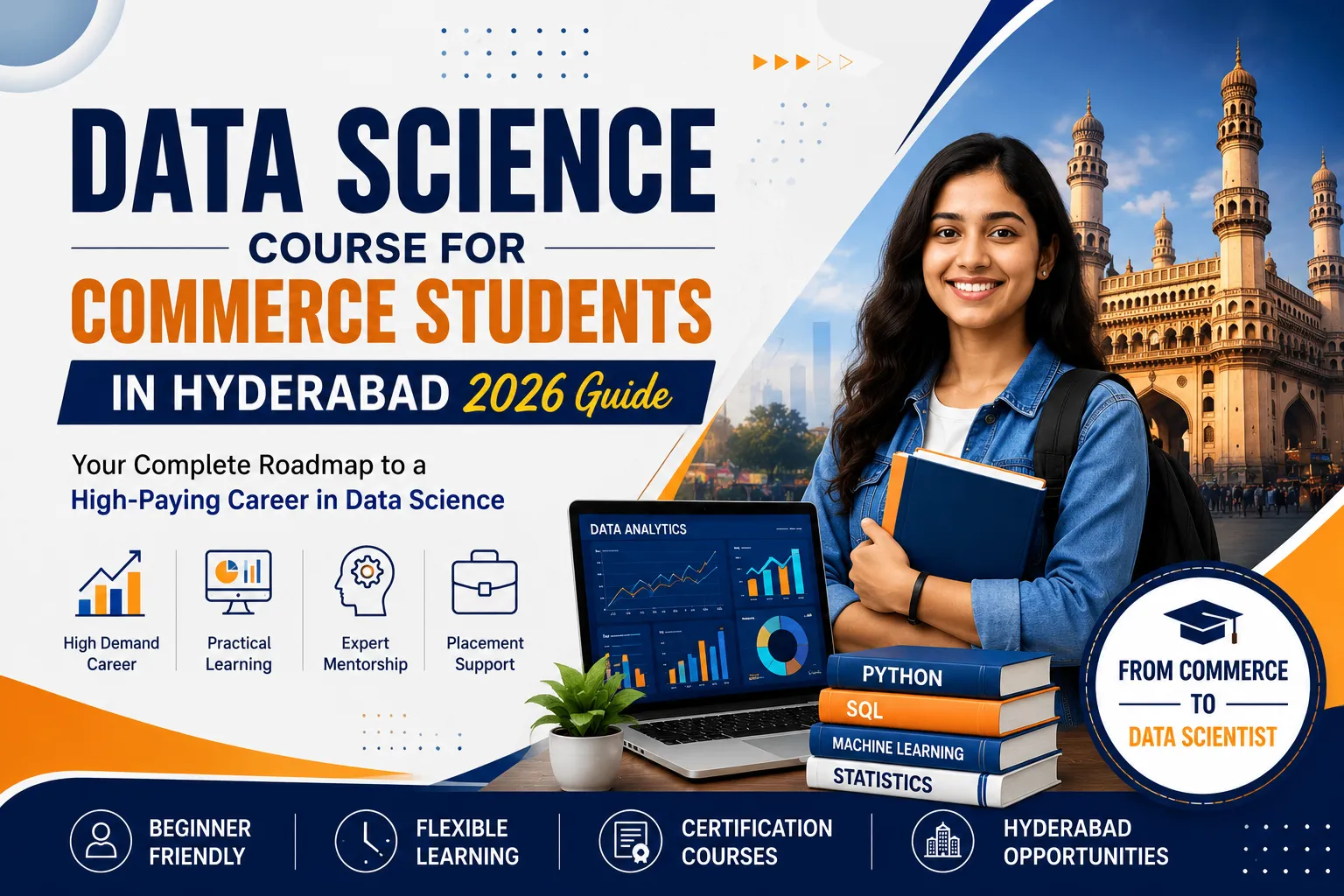
Can Commerce Students Learn Data Science?
Yes, Commerce students can successfully learn data science and build rewarding careers in analytics, business intelligence, artificial intelligence, and data-driven business roles. Contrary to popular belief, you do not need an engineering or computer science background to begin your journey.
Today's organizations value professionals who can understand both business operations and data. Since Commerce students already possess knowledge of accounting, finance, economics, taxation, and business management, they have a strong foundation for learning data science. By adding technical skills such as Python, SQL, statistics, Power BI, and machine learning, Commerce graduates can become valuable assets across multiple industries.
Whether you have completed your 12th Commerce, B.Com, BBA, M.Com, or are a working professional looking for a career transition, data science offers excellent opportunities to grow in one of the fastest-evolving fields.
Unlike traditional career paths, data science focuses on solving real-world business problems using data. This makes it an excellent option for Commerce students who enjoy analytical thinking, logical reasoning, and decision-making.
Why Commerce Students Are Choosing Data Science
Businesses generate enormous amounts of data every day. Banks monitor millions of financial transactions, e-commerce platforms analyze customer purchasing behavior, insurance companies assess risk, and marketing teams evaluate campaign performance using analytics.
All these decisions depend on professionals who can collect, analyze, and interpret data effectively.
Commerce students naturally understand many business concepts, including:
- Financial reporting
- Business operations
- Consumer behavior
- Economics
- Cost analysis
- Profitability
- Investment decisions
When these business skills are combined with modern technologies like Python, SQL, Power BI, and Machine Learning, Commerce graduates become highly valuable to organizations seeking data-driven decision-makers.
This growing demand is one of the primary reasons why many Commerce students are now choosing Data Science courses in Hyderabad.
What Is Data Science?
Data science is the process of collecting, organizing, analyzing, and interpreting data to help organizations make informed decisions.
Rather than relying on assumptions, businesses use data science to discover trends, identify opportunities, predict future outcomes, and improve business performance.
A typical data science workflow includes:
- Collecting raw data
- Cleaning and organizing information
- Analyzing patterns
- Creating visual reports
- Building predictive models
- Supporting business decisions
Modern data science combines multiple disciplines, including:
- Programming
- Statistics
- Mathematics
- Data Analysis
- Machine Learning
- Artificial Intelligence
- Data Visualization
- Business Intelligence
These skills help organizations improve efficiency, reduce costs, understand customers better, and develop innovative products and services.
Because every industry generates data, Data Scientists are needed across healthcare, finance, retail, education, manufacturing, logistics, telecommunications, and government sectors.
Can a Commerce Student Do Data Science?
Absolutely.
One of the biggest myths surrounding data science is that it is only meant for engineering or computer science students.
The reality is very different.
Many successful Data Analysts, Business Analysts, and Data Scientists come from Commerce, Economics, Business Administration, and other non-technical backgrounds.
Commerce students already possess several strengths that make learning data science easier.
These include:
- Logical thinking
- Business knowledge
- Financial understanding
- Decision-making ability
- Analytical mindset
- Problem-solving skills
A structured Data Science course simply adds technical skills to these existing strengths.
You'll gradually learn:
- Python Programming
- SQL
- Excel
- Statistics
- Power BI
- Tableau
- Machine Learning
- Artificial Intelligence
- Predictive Analytics
Most beginner-friendly courses start from the basics, so previous coding knowledge is not mandatory.
Why Commerce Students Have an Advantage
Many people assume technical skills alone determine success in data science.
However, employers often look for professionals who understand business problems—not just programming.
This is where Commerce students gain an advantage.
Your education already teaches you subjects such as:
- Accounting
- Economics
- Taxation
- Financial Management
- Business Law
- Auditing
- Marketing
- Cost Accounting
These concepts help you understand how businesses operate.
For example:
A bank needs professionals who understand customer transactions.
A retail company needs analysts who understand consumer buying behavior.
An insurance company needs professionals capable of assessing financial risks.
An investment firm requires experts who can interpret market data.
Commerce graduates already understand many of these business concepts.
When you combine that knowledge with technical tools like SQL, Python, and Power BI, you become capable of solving real business challenges through data.
This combination of business expertise and technical skills is one of the biggest advantages Commerce students have over candidates who possess only programming knowledge.
Can You Learn Data Science Without a Technical Background?
Yes.
Thousands of learners start their data science journey every year without any technical background.
Modern training programs are specifically designed for beginners.
Rather than introducing advanced algorithms immediately, quality courses follow a gradual learning path.
A beginner typically starts by learning:
- Basic computer concepts
- Python Programming
- SQL
- Excel
- Statistics
- Data Visualization
Only after developing confidence do students move toward more advanced topics like:
- Machine Learning
- Artificial Intelligence
- Predictive Analytics
- Deep Learning
- Generative AI
This step-by-step approach makes learning much easier for Commerce students.
The most important requirement isn't your educational background.
It's your willingness to learn consistently and practice regularly.
With proper guidance, hands-on projects, and real-world assignments, Commerce students can become highly skilled data professionals.
Can You Learn Data Science After 12th Commerce?
Yes. Students who complete their 12th Commerce can begin learning data science immediately through degree programs, diploma courses, certification programs, or industry-focused training. Unlike a few years ago, today's data science courses are designed for students from different educational backgrounds, including Commerce.
After completing Class 12, you have multiple learning pathways depending on your career goals. If you want an academic qualification, you can pursue undergraduate programs such as B.Sc. Data Science or BCA with Data Science. If your goal is to gain practical skills quickly and prepare for industry roles, certification programs and job-oriented bootcamps can be excellent options.
Many Commerce students also choose to pursue a B.Com while simultaneously enrolling in a Data Science certification course. This combination helps them graduate with both academic knowledge and industry-ready technical skills, making them more competitive in the job market.
Starting early also gives students more time to build projects, participate in internships, and develop practical experience before graduation.
Can You Learn Data Science After 12th Commerce Without Maths?
One of the biggest concerns among Commerce students is whether mathematics is compulsory for learning data science.
The answer is yes, you can begin learning data science even if you did not study advanced mathematics, especially through beginner-friendly certification programs.
While mathematics and statistics are important components of data science, modern training institutes introduce these concepts gradually rather than expecting students to master them before joining.
Initially, students focus on:
- Basic Statistics
- Logical Reasoning
- Data Interpretation
- Problem Solving
- Python Programming
- SQL
As the course progresses, learners naturally become familiar with probability, statistical analysis, and machine learning concepts.
For degree programs offered by universities, admission criteria may differ. Some institutions require Mathematics at the 10+2 level, while others have their own eligibility rules. Therefore, always check the specific admission requirements before applying.
For industry-oriented certification courses, prior mathematics knowledge is generally not mandatory.
Which Course Is Best for Becoming a Data Scientist After 12th Commerce?
The ideal course depends on your long-term career goals.
If your objective is to obtain a university degree, undergraduate programs may be the right choice. If you want to become job-ready faster through practical learning, certification courses and bootcamps are often more suitable.
Instead of selecting a course based only on its name, evaluate the curriculum carefully.
A quality Data Science course should include:
- Python Programming
- SQL and Database Management
- Statistics
- Data Analysis
- Excel for Analytics
- Power BI
- Tableau
- Machine Learning
- Artificial Intelligence Fundamentals
- Generative AI
- Real-world Projects
- Capstone Project
- Career Support
Hands-on learning is far more valuable than theoretical knowledge alone. Employers generally prefer candidates who can demonstrate practical experience through projects and portfolios.
If possible, choose a program that offers live mentoring, project-based learning, mock interviews, and placement assistance.
Common Myths Commerce Students Believe
Many Commerce students hesitate to enter the field of data science because of misconceptions. Let's address some of the most common myths.
Myth 1: Only Engineering Students Can Learn Data Science
This is one of the biggest misconceptions. Data science welcomes learners from Commerce, Science, Arts, Business Administration, Economics, and many other backgrounds. Success depends more on your willingness to learn than on your academic stream.
Myth 2: I Must Know Coding Before Joining
Most beginner-friendly Data Science courses start with Python from the basics. You do not need prior programming experience to begin your learning journey.
Myth 3: Commerce Students Cannot Understand Machine Learning
Machine Learning is taught gradually after students understand data analysis, statistics, and programming. With consistent practice, Commerce students can master these concepts successfully.
Myth 4: Data Science Jobs Exist Only in IT Companies
Data Science professionals are employed in banking, finance, healthcare, retail, e-commerce, manufacturing, consulting, education, logistics, telecommunications, insurance, and government organizations. The demand extends far beyond software companies.
Understanding the reality behind these myths helps students make informed career decisions without unnecessary fear or confusion.
Why Data Science Is a Natural Career Extension for Commerce Students
Commerce students spend years learning how businesses operate. They understand financial statements, market trends, accounting principles, taxation, customer behavior, and organizational decision-making.
Data science builds upon this knowledge by adding technical skills that allow professionals to analyze business data more effectively.
Instead of making decisions based only on experience, organizations now rely on analytics to:
- Forecast sales
- Analyze customer behavior
- Detect fraudulent transactions
- Improve operational efficiency
- Measure business performance
- Optimize marketing campaigns
- Predict future demand
- Reduce financial risks
Commerce graduates already understand the business side of these challenges.
Learning Python, SQL, Power BI, Machine Learning, and Data Visualization simply equips them with modern tools to solve these problems using data.
This combination of business expertise and analytical skills creates excellent career opportunities in Business Intelligence, Financial Analytics, Risk Analytics, Marketing Analytics, FinTech, and Artificial Intelligence.
As businesses continue adopting data-driven decision-making, Commerce students who develop technical skills will remain highly valuable across industries.
Can I Do a Data Science Course After B.Com?
Yes. A Bachelor of Commerce (B.Com) is one of the most common educational backgrounds for students entering the field of data science. While B.Com focuses on accounting, finance, taxation, economics, business law, and management, data science complements these subjects by adding analytical and technical skills that are increasingly in demand across industries.
Today's employers look for professionals who can not only understand business operations but also interpret data to support strategic decisions. A B.Com graduate who learns Python, SQL, Power BI, statistics, and machine learning can bridge the gap between business and technology.
Whether your goal is to work in banking, financial services, consulting, retail, fintech, insurance, or digital marketing, data science can significantly expand your career opportunities.
Many beginners worry that they have "the wrong degree" for data science. In reality, companies value practical skills, problem-solving abilities, and project experience much more than the title of your undergraduate degree.
If you are willing to learn continuously and apply your knowledge through real-world projects, a B.Com degree can become a strong foundation for building a successful career in analytics and data science.
Why B.Com Graduates Are Choosing Data Science
The business world has changed dramatically over the last decade.
Organizations no longer rely solely on experience or intuition when making decisions. Instead, they use data to understand customer behavior, forecast sales, optimize operations, reduce costs, and improve profitability.
Because B.Com graduates already understand financial statements, accounting principles, taxation, auditing, business management, and economics, they naturally understand how businesses function.
By learning technical tools such as:
- Python Programming
- SQL
- Excel
- Power BI
- Tableau
- Machine Learning
they gain the ability to transform business data into meaningful insights.
Some common business problems solved through data science include:
- Predicting customer purchasing behavior
- Detecting fraudulent financial transactions
- Analyzing investment performance
- Forecasting product demand
- Measuring marketing campaign effectiveness
- Optimizing inventory management
- Improving customer retention
This combination of business knowledge and analytical skills makes Commerce graduates highly valuable in today's job market.
Career Opportunities After B.Com in Data Science
One of the biggest advantages of learning data science after B.Com is the wide variety of career options available.
Instead of limiting yourself to traditional Commerce careers, you can explore roles across multiple industries where data-driven decision-making plays an important role.
Popular career options include:
- Data Analyst
- Business Analyst
- Financial Data Analyst
- Business Intelligence Analyst
- Risk Analyst
- Marketing Analyst
- Junior Data Scientist
- Analytics Consultant
- Product Analyst
- Operations Analyst
These roles are available in industries such as:
- Banking
- Financial Services
- FinTech
- Insurance
- Retail
- E-commerce
- Healthcare
- Manufacturing
- Logistics
- Consulting
- Telecommunications
As you gain experience, you can progress into advanced positions like Senior Data Scientist, Machine Learning Engineer, Analytics Manager, AI Consultant, or Data Engineering Specialist.
Continuous learning and practical project experience play a major role in long-term career growth.
Data Science Course for Commerce Students Online
Online learning has made quality data science education accessible to students regardless of their location.
Whether you are studying for a B.Com, preparing for competitive exams, working full-time, or managing a business, online learning allows you to build valuable technical skills without relocating.
Modern online courses offer interactive learning experiences that closely resemble classroom training.
Many programs include:
- Live instructor-led classes
- Hands-on coding sessions
- Assignments
- Project reviews
- Mentor support
- Doubt-clearing sessions
- Career guidance
- Mock interviews
This flexibility allows students to learn at their own pace while balancing academic or professional commitments.
Who Should Choose an Online Data Science Course?
Online learning is suitable for:
- 12th Commerce students
- B.Com students
- BBA graduates
- M.Com graduates
- MBA students
- Working professionals
- Entrepreneurs
- Freelancers
- Career changers
As long as you have a computer, internet connection, and willingness to practice consistently, online learning can be just as effective as classroom training.
Benefits of Learning Data Science Online
Online courses offer several advantages.
Some of the biggest benefits include:
- Flexible schedules
- Learn from anywhere
- Live mentor guidance
- Recorded sessions for revision
- Affordable learning options
- Access to industry experts
- Real-world projects
- Placement preparation
- Resume building
- Interview support
Many learners appreciate the ability to continue their education while pursuing college or maintaining full-time employment.
Free Data Science Course for Commerce Students
If you're still exploring whether data science is the right career path, starting with free learning resources can be an excellent decision.
Free resources allow beginners to understand the basics before investing in a structured certification program.
You can begin learning topics such as:
- Python Programming
- Excel
- SQL
- Statistics
- Data Visualization
- Exploratory Data Analysis
- Machine Learning fundamentals
Free courses are ideal for developing confidence and understanding fundamental concepts.
However, they usually do not provide personalized mentoring, project feedback, career support, or placement assistance.
Therefore, many learners eventually enroll in structured programs after building a solid foundation.
Free Online Data Science Courses with Certificates
Several online learning platforms provide introductory data science courses along with certificates upon completion.
These certificates can help you:
- Demonstrate initiative
- Build confidence
- Understand industry concepts
- Strengthen your resume
- Explore different areas of data science
However, employers generally place greater importance on:
- Practical projects
- Technical skills
- GitHub portfolio
- Real-world problem-solving
- Internship experience
Certificates add value only when supported by hands-on experience.
Should You Start with Free Courses?
Free courses are an excellent starting point if you are unsure about pursuing data science as a career.
They help you understand:
- Whether you enjoy programming
- Your interest in analytics
- Basic technical concepts
- Industry tools
- Learning pace
Once you gain confidence, enrolling in a structured course with mentorship, live projects, and placement support can help accelerate your career growth.
Should You Choose a Certification Course?
For many Commerce students, a certification course is one of the fastest and most practical ways to begin a career in data science. Unlike traditional degree programs that focus heavily on theory, certification courses are usually designed to develop industry-ready skills through practical learning, live projects, and hands-on experience.
Whether you're pursuing a B.Com, have recently graduated, or are planning a career switch, a well-structured certification course can help you gain the technical knowledge employers expect. Most beginner-friendly programs start from the fundamentals, making them suitable even for students with no prior programming experience.
Before enrolling, evaluate whether the course emphasizes practical applications rather than just theoretical concepts. The best certification programs help learners build confidence by solving real-world business problems using data.
A quality certification course should prepare you to analyze data, create dashboards, build predictive models, and communicate insights effectively. These practical abilities often have a greater impact on employability than simply earning a certificate.
Benefits of a Data Science Certification
A professional certification provides several advantages beyond classroom learning.
Some of the key benefits include:
- Learning industry-relevant tools and technologies
- Working on real-world datasets
- Building an impressive project portfolio
- Understanding business case studies
- Improving problem-solving skills
- Preparing for technical interviews
- Receiving guidance from experienced mentors
- Developing confidence through hands-on practice
Many certification programs also provide internship opportunities, resume preparation, and placement assistance, making the transition into the workforce much smoother.
What Should a Good Certification Include?
Not every certification course offers the same learning experience. Before enrolling, carefully compare the curriculum and training methodology.
An industry-focused Data Science certification should include:
- Python Programming
- SQL and Database Management
- Statistics
- Data Analysis
- Data Cleaning
- Exploratory Data Analysis (EDA)
- Power BI
- Tableau
- Machine Learning
- Artificial Intelligence Fundamentals
- Generative AI Concepts
- Capstone Projects
- Git and GitHub
- Interview Preparation
- Resume Building
- Placement Assistance
The more opportunities you have to work on practical projects, the better prepared you'll be for interviews and real-world job responsibilities.
Degree vs Certification Course
Both degree programs and certification courses have their own advantages.
A university degree provides academic knowledge and long-term educational qualifications, while certification courses primarily focus on practical skills and industry readiness.
If your goal is to become job-ready quickly, a certification course often provides faster exposure to modern tools and technologies.
Many students successfully combine both approaches by pursuing a B.Com degree while simultaneously completing a professional Data Science certification. This combination provides both academic credentials and practical experience.
The right choice depends on your career goals, available time, budget, and preferred learning style.
Data Science Course Fees and Duration
The duration and cost of a Data Science course vary depending on the type of program, learning format, curriculum, and level of support offered.
Instead of selecting a course based only on its fees, consider the overall value it provides. A slightly higher investment may include live mentoring, real-world projects, career support, internship opportunities, and placement assistance.
Generally, shorter certification programs focus on practical skills, while degree programs provide broader academic education over several years.
Before enrolling, compare what each course includes rather than making a decision based solely on price.
Typical Course Duration
The duration of a Data Science course depends on your chosen learning path.
Common program durations include:
- Certification Courses – Approximately 3 to 6 months
- Diploma Programs – Around 6 to 12 months
- Industry Bootcamps – Approximately 4 to 8 months
- Bachelor's Degree Programs – 3 to 4 years
- Master's Degree Programs – Around 2 years
Working professionals often prefer weekend or live online programs that allow them to continue learning while maintaining their current jobs.
Data Science Course Fee Structure
Course fees differ from one institute to another based on several factors.
These include:
- Curriculum quality
- Faculty expertise
- Live mentoring
- Project-based learning
- Learning format
- Career support
- Placement assistance
- Certification value
Instead of comparing only the fee amount, ask questions such as:
- Does the course include real-world projects?
- Are mentors available for guidance?
- Is interview preparation provided?
- Will I build a professional portfolio?
- Is placement support available?
These factors contribute significantly to your career readiness.
Data Science & AI Course Fees in Hyderabad
Many institutes now combine Data Science and Artificial Intelligence into a single comprehensive program.
These courses generally include topics such as:
- Python Programming
- SQL
- Statistics
- Data Analysis
- Power BI
- Machine Learning
- Deep Learning
- Artificial Intelligence
- Generative AI
- Large Language Models (LLMs)
The overall course fee depends on curriculum depth, learning format, mentor interaction, and additional services offered.
Rather than selecting the least expensive course, focus on finding a program that provides practical exposure, experienced trainers, career guidance, and opportunities to build a strong portfolio.
Skills Every Commerce Student Should Learn
Success in Data Science depends on building a combination of technical expertise and business understanding.
Commerce students already possess valuable knowledge of finance, accounting, economics, and business operations. The next step is developing technical skills that help transform business data into meaningful insights.
A structured learning roadmap helps students gradually develop confidence while preparing for industry requirements.
Technical Skills Required for Data Science
Every aspiring Data Science professional should become familiar with the following technologies:
- Python Programming
- SQL
- Microsoft Excel
- Statistics
- Data Cleaning
- Exploratory Data Analysis (EDA)
- Power BI
- Tableau
- Machine Learning
- Artificial Intelligence
- Generative AI
- Git and GitHub
These tools form the technical foundation of modern analytics and Data Science careers.
Business Skills That Give Commerce Students an Edge
Technical knowledge alone isn't enough.
Commerce students often possess business skills that employers highly value.
These include:
- Financial Analysis
- Business Communication
- Accounting Knowledge
- Budget Planning
- Decision Making
- Critical Thinking
- Presentation Skills
- Commercial Awareness
- Business Strategy
- Customer Understanding
When combined with technical expertise, these skills help professionals convert data into meaningful business decisions.
Beginner Roadmap for Commerce Students
If you're starting your Data Science journey from a Commerce background, it's important to follow a structured learning path. Trying to learn everything at once can feel overwhelming, so focusing on one topic at a time helps you build a strong foundation.
A beginner-friendly roadmap starts with programming and gradually introduces analytics, visualization, machine learning, and AI concepts. Each stage builds upon the previous one, making it easier to understand advanced topics.
Here's a practical roadmap that many successful Data Science professionals follow:
Stage 1: Learn Python Programming
Understand variables, loops, functions, data structures, and object-oriented programming.
Stage 2: Learn SQL and Databases
Practice retrieving, filtering, and managing data using SQL queries.
Stage 3: Master Excel for Data Analysis
Learn formulas, Pivot Tables, charts, dashboards, and data cleaning techniques.
Stage 4: Study Statistics and Probability
Understand averages, distributions, correlation, hypothesis testing, and probability concepts.
Stage 5: Learn Data Visualization
Use tools like Power BI and Tableau to create interactive dashboards and reports.
Stage 6: Explore Machine Learning Fundamentals
Learn supervised and unsupervised learning, regression, classification, clustering, and model evaluation.
Stage 7: Build Real-World Projects
Work on business datasets related to finance, retail, banking, healthcare, and marketing.
Stage 8: Create a Professional Portfolio
Upload projects to GitHub, build dashboards, document your work, and prepare for interviews.
Following this roadmap consistently will help you become job-ready while developing practical skills employers expect.
Why Consistency Matters More Than Speed
Many beginners compare themselves with experienced professionals and become discouraged.
Remember that Data Science is a skill built through continuous learning and practice.
Instead of trying to finish an entire course quickly, focus on:
- Practicing coding every day
- Solving small business problems
- Working on real datasets
- Revising concepts regularly
- Building one project at a time
Even one hour of focused learning every day can produce significant improvements over time.
Building a Strong Portfolio
Employers often ask candidates to demonstrate what they have built rather than simply listing certifications.
Your portfolio should include projects such as:
- Sales Dashboard
- Customer Segmentation Analysis
- Financial Data Analysis
- Bank Loan Prediction
- Fraud Detection
- Retail Sales Forecasting
- Employee Performance Analysis
- Marketing Campaign Analysis
Each project should clearly explain:
- Business Problem
- Dataset Used
- Data Cleaning Process
- Analysis Performed
- Visualizations Created
- Business Insights
- Final Conclusion
A strong portfolio significantly improves your chances of securing interviews.
Mistakes Commerce Students Should Avoid
Many students delay their career growth because of avoidable mistakes.
Being aware of these common challenges can save both time and effort.
Choosing a Course Based Only on Fees
The cheapest course isn't always the best.
Before enrolling, compare:
- Curriculum quality
- Live classes
- Industry projects
- Mentor support
- Placement assistance
- Student reviews
Investing in quality training often provides better long-term returns.
Focusing Only on Certificates
Certificates are useful, but employers primarily evaluate your practical skills.
Instead of collecting multiple certificates, spend time:
- Building projects
- Practicing coding
- Solving business problems
- Learning new tools
- Improving communication skills
Projects demonstrate your abilities much better than certificates alone.
Ignoring Statistics
Some students focus only on learning Python while avoiding statistics.
However, statistics forms the foundation of data analysis and machine learning.
Understanding concepts such as:
- Mean
- Median
- Standard Deviation
- Probability
- Correlation
- Hypothesis Testing
will make advanced topics much easier.
Avoiding Hands-on Practice
Watching videos alone won't make you job-ready.
Real learning happens when you:
- Write code
- Analyze datasets
- Build dashboards
- Fix errors
- Experiment with different solutions
Practice transforms theoretical knowledge into practical expertise.
Career Opportunities for Commerce Students After a Data Science Course
One of the biggest advantages of learning Data Science is the wide range of career opportunities available across industries.
Commerce students possess valuable business knowledge that complements technical skills, making them suitable for roles requiring both analytical thinking and business understanding.
Organizations today depend on data to improve decision-making, increase profitability, reduce costs, and understand customer behavior.
As a result, demand for professionals who can interpret business data continues to grow.
Whether you want to work in finance, banking, consulting, healthcare, retail, or technology, Data Science skills can open numerous career paths.
Best Career Options for Commerce Students
After completing a Data Science course, Commerce students can explore various job roles.
Some of the most popular career options include:
- Data Analyst
- Business Analyst
- Financial Data Analyst
- Risk Analyst
- Business Intelligence Analyst
- Marketing Analyst
- Product Analyst
- Operations Analyst
- Junior Data Scientist
- Analytics Consultant
These roles involve collecting data, analyzing trends, creating reports, building dashboards, and supporting strategic business decisions.
As your experience grows, you can advance into senior positions such as:
- Senior Data Scientist
- Machine Learning Engineer
- AI Engineer
- Analytics Manager
- Data Engineering Specialist
- AI Consultant
Career progression depends on continuous learning, project experience, and professional development.
Industries That Hire Commerce Students with Data Science Skills
Data Science isn't limited to software companies.
Almost every industry generates data and requires professionals who can analyze it effectively.
Commerce students can build careers in:
- Banking
- Financial Services
- FinTech
- Insurance
- Retail
- E-commerce
- Healthcare
- Manufacturing
- Logistics
- Telecommunications
- Consulting
- Digital Marketing
- Education
- Real Estate
This versatility makes Data Science one of the most flexible career options available today.
Future Scope of Data Science for Commerce Graduates
The future of Data Science continues to look promising.
Organizations are investing heavily in:
- Artificial Intelligence
- Machine Learning
- Business Analytics
- Automation
- Cloud Computing
- Predictive Analytics
- Generative AI
As businesses become increasingly data-driven, professionals who understand both business operations and analytics will remain in high demand.
Commerce graduates who continuously update their technical skills can expect strong long-term career growth across multiple industries.
Career Opportunities for Commerce Students After a Data Science Course
One of the biggest advantages of learning data science as a Commerce student is that your business knowledge becomes a competitive advantage. While many technical professionals understand programming, Commerce students often understand finance, accounting, business operations, customer behavior, and economics. When combined with data science skills, this creates opportunities across industries—not just in IT.
Today, organizations in banking, fintech, e-commerce, consulting, healthcare, insurance, retail, and manufacturing all hire professionals who can interpret data and support business decisions.
Best Career Options for Commerce Students
After completing a data science course, you can explore roles such as:
| Job Role | Primary Responsibilities |
| Data Analyst | Analyze business data and prepare reports |
| Business Analyst | Improve business processes using data insights |
| Financial Data Analyst | Analyze financial performance and investment data |
| Risk Analyst | Identify financial and operational risks |
| Marketing Analyst | Measure campaign performance and customer behavior |
| Business Intelligence (BI) Analyst | Build dashboards and business reports |
| Junior Data Scientist | Build predictive models and analyze datasets |
| Analytics Consultant | Help organizations solve business problems with data |
Many Commerce graduates begin as Data Analysts or Business Analysts before moving into specialized roles in Machine Learning or AI.
Industries That Hire Commerce Students with Data Science Skills
One of the reasons data science is attractive is that almost every industry generates data.
Commerce students can work in sectors including:
- Banking
- Financial Services
- Insurance
- Accounting
- FinTech
- Retail
- E-commerce
- Healthcare
- Manufacturing
- Logistics
- Telecommunications
- Consulting
- Digital Marketing
This flexibility allows professionals to apply their existing business knowledge while learning modern analytical tools.
What After 12th Commerce for a High-Salary Career?
Students often wonder which career offers the best long-term growth after choosing Commerce.
There isn't a single "best" option because every career has different responsibilities, learning requirements, and growth opportunities.
Popular career choices after 12th Commerce include:
- Chartered Accountant (CA)
- Company Secretary (CS)
- Cost and Management Accounting (CMA)
- Bachelor of Commerce (B.Com)
- Bachelor of Business Administration (BBA)
- Business Analytics
- Data Science
- Artificial Intelligence
- Digital Marketing
- Financial Analytics
If you enjoy solving problems with numbers, technology, and business insights, data science can be an exciting career path.
The best choice ultimately depends on your interests, strengths, and long-term goals.
Who Earns More: CA or Data Scientist?
This is one of the most searched questions among Commerce students.
The answer isn't straightforward because these careers follow different paths.
| Chartered Accountant | Data Scientist |
| Focuses on accounting, auditing, taxation, and compliance | Focuses on data analysis, machine learning, and business insights |
| Strong demand in finance and compliance | Strong demand across multiple industries |
| Professional qualification | Technical and analytical specialization |
| Career growth depends on industry and expertise | Career growth depends on technical skills, projects, and experience |
Rather than comparing salaries alone, choose the profession that aligns with your interests.
Students who enjoy financial reporting, taxation, and auditing may prefer CA.
Those who enjoy technology, analytics, programming, and business intelligence may find data science more engaging.
Both careers can provide excellent long-term opportunities.
Is Data Science an IT Job?
Data science is closely related to Information Technology, but it extends beyond traditional IT roles.
A Data Scientist works with:
- Data analysis
- Statistics
- Programming
- Machine Learning
- Artificial Intelligence
- Business Intelligence
However, they also collaborate with:
- Finance teams
- Marketing departments
- Operations managers
- Sales teams
- Product managers
- Business leaders
Their role is to transform data into actionable insights that improve decision-making.
This makes data science a multidisciplinary field that combines technology with business.
Is Data Science a Good Career for Commerce Students?
Yes.
Commerce students often bring strengths that complement technical knowledge.
These include:
- Financial understanding
- Business strategy
- Market awareness
- Communication skills
- Analytical thinking
- Decision-making
After learning Python, SQL, statistics, and machine learning, Commerce graduates can apply these business skills to solve complex organizational challenges.
As companies increasingly rely on data-driven decision-making, professionals who understand both business and analytics are becoming more valuable.
What Skills Employers Expect from Commerce Graduates?
Completing a course is only the beginning.
Employers want candidates who can demonstrate practical knowledge through projects and problem-solving rather than relying only on certifications.
Technical Skills
A modern Data Science course should help Commerce students develop expertise in:
- Python Programming
- SQL
- Excel
- Statistics
- Data Cleaning
- Exploratory Data Analysis (EDA)
- Power BI
- Tableau
- Machine Learning
- Deep Learning Fundamentals
- Generative AI Concepts
- Git & GitHub
These technical skills prepare you to work with real-world datasets, automate analysis, create dashboards, and build predictive models that businesses use every day.
Business Skills That Make Commerce Students Stand Out
One of the biggest advantages Commerce students have is their business knowledge.
Employers value professionals who understand both business operations and data analysis.
Important business skills include:
- Accounting Principles
- Financial Reporting
- Business Operations
- Customer Behaviour Analysis
- Cost Analysis
- Budget Planning
- Business Communication
- Critical Thinking
- Presentation Skills
- Decision Making
When combined with programming and analytics, these skills help you provide meaningful business insights instead of simply generating reports.
Why Hyderabad Is a Great Place to Learn Data Science
Hyderabad has become one of India's fastest-growing technology hubs and offers excellent career opportunities for aspiring data professionals.
The city is home to leading companies in:
- Software Development
- Artificial Intelligence (AI)
- FinTech
- Healthcare Technology
- Cloud Computing
- Cybersecurity
- Data Analytics
This growing ecosystem creates a strong demand for skilled Data Analysts, Business Analysts, AI Engineers, and Data Scientists.
Benefits of Learning Data Science in Hyderabad
Studying Data Science in Hyderabad offers several advantages, including:
- Access to leading IT companies
- Internship opportunities
- Industry networking events
- Live workshops and seminars
- Experienced trainers and mentors
- Better placement opportunities
- Exposure to real-world business projects
Students also benefit from Hyderabad's startup ecosystem, where analytics and AI skills are increasingly in demand.
How to Choose the Best Data Science Institute
Choosing the right institute is just as important as selecting the right course.
Before enrolling, compare different institutes based on curriculum, trainers, projects, and placement support.
Updated Industry Curriculum
A quality institute should teach the latest industry tools, including:
- Python
- SQL
- Statistics
- Excel
- Power BI
- Tableau
- Machine Learning
- Deep Learning
- Generative AI
- Large Language Models (LLMs)
A modern curriculum ensures you're learning technologies currently used by companies.
Practical Learning
Employers prefer candidates with hands-on experience.
Choose an institute that provides:
- Real-world datasets
- Live coding sessions
- Industry case studies
- Capstone projects
- Portfolio development
- Mini projects after every module
Practical learning improves confidence and interview performance.
Experienced Mentors
Learning from experienced professionals helps you understand concepts faster and avoid common mistakes.
Good mentors can help you:
- Solve coding problems
- Review projects
- Explain difficult topics
- Prepare for interviews
- Build confidence
Career Support
A good Data Science institute should offer career assistance beyond classroom training.
Look for services such as:
- Resume Building
- LinkedIn Profile Optimization
- Mock Interviews
- Soft Skills Training
- Career Counselling
- Placement Assistance
These services improve your chances of getting your first job in Data Science.
Flexible Learning Options
Different students have different schedules.
Choose an institute that offers:
- Classroom Training
- Live Online Classes
- Hybrid Learning
- Weekend Batches
- Evening Batches
Flexible learning makes it easier for college students and working professionals to continue their education without disrupting their existing commitments.
Why Commerce Students Choose Vijanaar
If you're searching for a Data Science Course in Hyderabad, it's important to choose a program that combines technical skills with real-world business applications.
At Vijanaar, students learn through a structured curriculum designed to prepare them for today's data-driven industries. The course focuses on practical learning, hands-on projects, and industry-relevant tools rather than just theoretical concepts.
Industry-Focused Curriculum
The curriculum is designed to help beginners and Commerce graduates build strong technical foundations.
Students learn:
- Python Programming
- SQL
- Statistics
- Data Analysis
- Microsoft Excel
- Power BI
- Tableau
- Machine Learning
- Deep Learning Fundamentals
- Generative AI Concepts
- Large Language Models (LLMs)
The course also includes real-world case studies and capstone projects that simulate actual business scenarios.
Hands-on Learning Experience
Practical learning is a major part of the program.
Students get opportunities to work on:
- Live Projects
- Industry Case Studies
- Business Analytics Projects
- Data Visualization Dashboards
- Machine Learning Models
- Real Business Datasets
This project-based approach helps learners build a professional portfolio before applying for jobs.
Career Support Services
Apart from technical training, students receive complete career guidance.
Support includes:
- Resume Preparation
- LinkedIn Profile Optimization
- Mock HR Interviews
- Technical Interview Preparation
- Career Mentoring
- Placement Assistance
The goal is to prepare students for real interviews and improve their employability.
Who Can Join?
The course is suitable for:
- 12th Commerce Students
- B.Com Students
- BBA Students
- M.Com Graduates
- MBA Graduates
- Working Professionals
- Career Changers
- Entrepreneurs
Even students with no prior programming knowledge can begin learning through beginner-friendly modules.
Frequently Asked Questions
Can a Commerce Student Go for Data Science?
Can I Do a Data Science Course After B.Com?
Which Course Is Best for Data Science?
Can I Do Data Science After 12th Commerce Without Maths?
Written by VijaNaar
VijaNaar is Hyderabad's leading AI & Data Science training institute, empowering students and professionals with industry-ready skills since 2019.


